

Introduction
While green jobs are often associated with employment in renewable energy infrastructure like solar panel installation or wind farm maintenance, climate policies affect a much broader range of occupations, including engineers, accountants, and sustainability officers.
Traditional assessments of job adaptability across sectors, or job resilience, in a low-carbon economy have primarily focused on sector-specific emissions. However, this approach overlooks the crucial role of skills in defining job adaptability across different sectors.
Measuring and understanding job resilience is crucial to ensuring that workers are well-prepared for the green transition, and how institutions can collaborate to supply them with the skills needed to develop their capabilities. To illustrate this point, our research examined the Saudi labor market using a novel Transition Risk Index for employment. The data reveals that Saudi employment features a substantial engineering workforce, which represents one of the most adaptable skill sets for the green transition. Saudi Arabia's overall occupational adaptability to a green economy is broadly comparable to that of leading green economies like the UK. We highlight several policy directions that could be applied at a global scale to sustain skills resilience for the future of work.
Industry-based and Skill-based Understanding of Green Jobs
Conventionally, a sector’s emissions intensity, how much CO2 it emits per unit of economic output, determines how exposed the jobs in that sector are to the immediate climate policy effects like a production cost increase. This is why emissions linked to sectors often influence perceptions about job resilience for what we expect will be an increasingly green future. It is understandable that many consider fossil fuel-producing economies to be less prepared for transitions. This approach is incomplete, however, as job resilience also depends on the specific skill sets needed to perform tasks in low-carbon economies. As these skills define our occupations and can be drawn from any existing sector, a more comprehensive approach would consider both sectors and occupations in measuring job resilience.
Cian Mulligan is a Research Fellow at KAPSARC. Aya Kachi is an Associate Professor at the University of Basel and an Adjunct Professor at the KAPSARC School of Public Policy. Emre Hatipoglu is an Associate Professor at the KAPSARC School of Public Policy and Principal Fellow at KAPSARC. Manuel Ebner is a researcher, data scientist, and Ph.D. candidate at the University of Basel.
Identifying Resilience and Risks
Our research initially showed that Saudi Arabia's economic sectors emit more than, for example, UK counterparts. In other words, from a sector perspective, Saudi jobs may be more exposed to the potential effects of low-carbon policies. However, Saudi Arabian employment features a notably high proportion of engineers, management, and executives, skill sets that play fundamental roles across sectors and are highly transferable to emerging sustainability-focused jobs, such as energy efficiency and carbon management. When considering the average occupational adaptability weighted by employment share, the analysis indicates comparable adaptability to a low-carbon future between the two countries. The difference in sectoral carbon exposure becomes less pronounced. This reinforces the need to assess workforce resilience beyond sectors and highlights the importance of measuring adaptability through skills.
This perspective invites us to rethink how we measure the greenness of jobs. That’s why we introduce the Transition Risk Index (TRI), which assesses resilience for each occupation using three key factors: sectoral carbon exposure, occupational skill adaptability, and labor market frictions, including regional unemployment. By integrating these dimensions, TRI offers a more comprehensive assessment of workforce adaptability than sector-based assessments alone.
Reference: Ebner, M., Kachi, A., & Montfort, S. (2024). Persistent Climate Policy Opinion Despite Corrected Job Risk Misconceptions. Available at SSRN 4919490: http://dx.doi.org/10.2139/ssrn.4919490
From a labor perspective, Saudi Arabia’s transition trajectory appears even more convincing. Our findings show positive indications for Saudi Arabia’s skills adaptability, as its average TRI improved from 0.36 in 2019 to 0.21 in 2022, reflecting a shift of jobs from medium-risk to low-risk categories, where the lower the number, the more adaptable. Our findings also highlight regional differences within the Kingdom. The analysis uses data provided by the National Labor Observatory (NLO) and only includes Saudi citizens.
Building a Resilient Labor Force: Policy Implications
These findings suggest the important role of policies and investments in enabling workers to adapt to the green transition, even in sectors with medium to high carbon exposure. Converting this human capability opportunity to sustain green-job resilience highlights several policy directions.
1. Focus on occupations rather than sectors to analyze pathways towards employment in a net zero future. The types of skills required in a specific occupation affect that occupation’s resilience.
2. Take good stock of competencies and skills. In a fast-changing environment, predicting the next critical competency in the green industry is challenging. The collection and dissemination of consistent and reliable data is key to understanding how countries can leverage skills stocks for the opportunities of the future.
3. Leverage adult education and reskilling. Building factories may take years, but shaping generations takes decades. Side-skilling and re-skilling targeted segments via adult education, such as through climate and sustainability courses offered to practitioners in institutions like the KAPSARC School of Public Policy, emerge as effective policy tools to address short-term challenges. This is in line with the Human Capability Initiative theme of "Harnessing the Ways We Learn," which sheds light on the importance of lifelong learning and skilling opportunities to enable individuals to remain competitive in the future of work.
Institutionalizing Resilience
The need for assessing skills resilience for the future goes beyond green jobs. The future holds many transition challenges that we know are coming in the future of work, as well as other challenges that have not appeared on the horizon yet. The analysis we present here can be applied to any country, constituting a blueprint to assess challenges and opportunities in this ever-changing global skills landscape.
Related Work by KAPSARC Researchers
Ebner, M., Kachi, A., & Montfort, S. (2024). Persistent Climate Policy Opinion Despite Corrected Job Risk Misconceptions. Available at SSRN 4919490: http://dx.doi.org/10.2139/ssrn.4919490
Mulligan, C. (2024). Measuring Green Jobs in Saudi Arabia, KAPSARC Discussion Paper, available at https://www.kapsarc.org/research/publications/measuring-green-jobs-in-saudi-arabia-saudis-in-green-occupations/, doi: 10.30573/KS-2024-DP28.
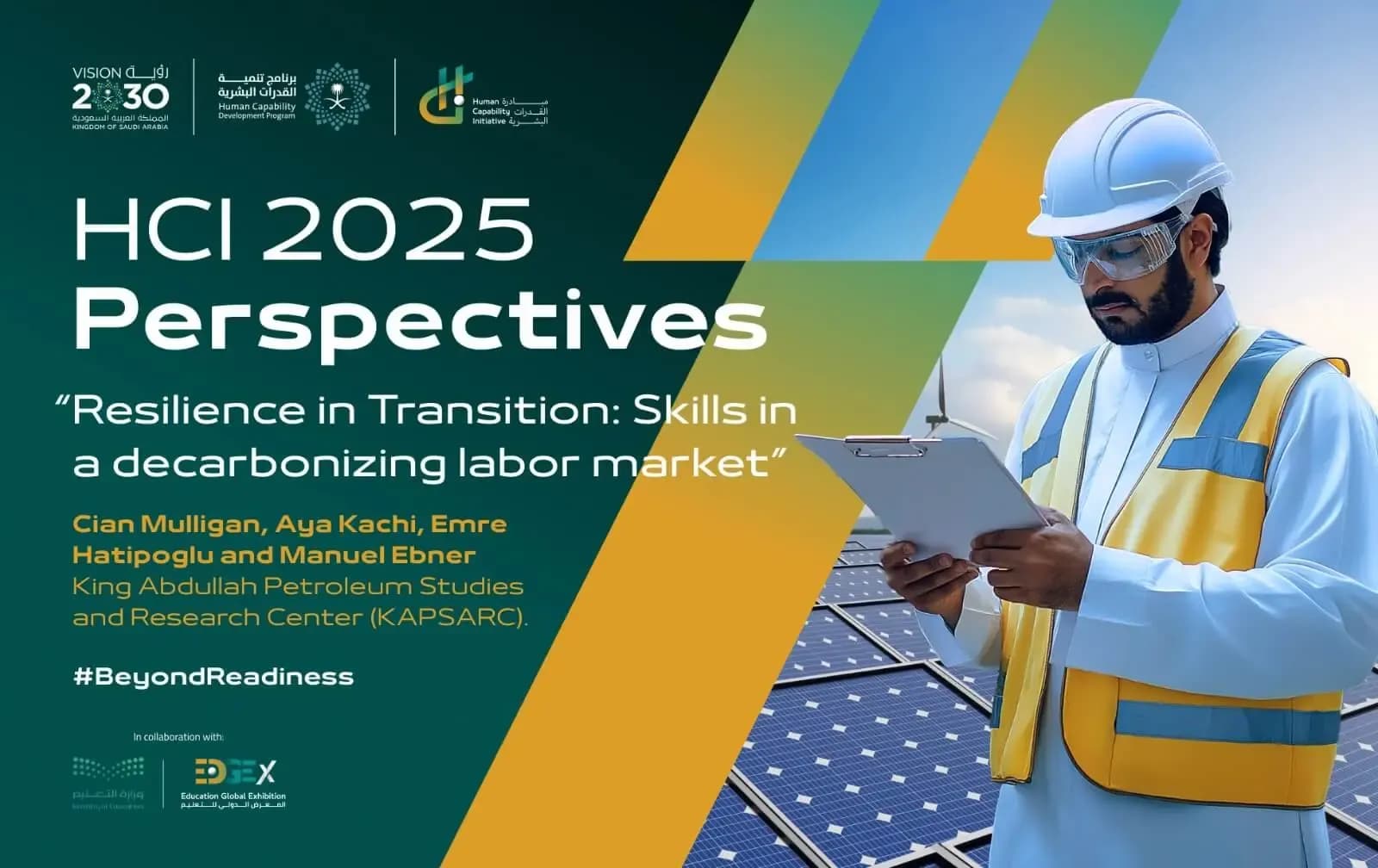
Cian Mulligan, Aya Kachi, Emre Hatipoglu, Manuel Ebner, King Abdullah Petroleum Studies and Research Center (KAPSARC).
Disclaimer: This report has been prepared by the King Abdullah Petroleum Studies and Research Center (KAPSARC). The views and opinions expressed in this report are those of the authors and do not necessarily reflect the views, policies, or positions of the Human Capability Development Program (HCDP), the host of the Human Capability Initiative (HCI) conference.


.png&w=384&q=75)